
Paris in history
- Bierman, John 1988 Napoleon III and his Carnival Empire. St Martin's Press, New York 439 pages.
- This focuses on the Second Empire of France (1851-1870). Much of the action takes place in Paris. Napoleon
(1808 - 1873) was supposed to be the nephew of the original, but there was always doubt about his paternity
because his parents were usually estranged. He was intent on taking over France following in his ancestor's
footsteps and made at least two bungled attempts at military uprisings. He was arrested both times, before
eventually taking over the Government by constitutional means, getting himself elected as President and then
taking over and giving himself more power. All his life he was a compulsive womanizer. He married Eugenie
because she refused him without marriage. She was the daughter of a Spanish mother and Scottish father and was
by all accounts very beautiful but found her husband repellent. After their son was born, their marriage
deteriorated though, by all accounts, they maintained an outward facade. She was a strong and dominant
personality and tried to steer Napoleon towards certain policies, including a disastrous attempt to set up a
monarchy in Mexico. It was also her pressure that led to Napoleon rejecting peace overtures from the Germans,
which ultimately led to the Franco-Prussian War of 1879, in which France was resoundingly and humiliatingly
defeated, with massive loss of life to the French army. This, of course, was exactly what the Prussian
Chancellor, Bismark, had wanted. It gave him an opportunity to demonstrate and test Prussian military might. The
Empress Eugenie is a good argument for the greater education of women. She was highly opinionated without being
intelligent or well educated. In fact, she seems to have been very ignorant, and was driven by rigid but fervent
religious beliefs. Bierman shows that Napoleon foreshadowed many of the political tactics that were used to such
devastating effect in the twentieth century, particularly shrewd manipulation of public opinion, the electoral
process and the media. All of which gave his actions at least the veneer of respectability and democracy. He
also used military activity and propaganda to deflect attention from problems at home. It seems that the mass of
French people were not much better off at the end of his regime than at the beginning, merely sharing in the
general prosperity that was a feature of 19th century Europe. Napoleon himself seems a very contradictory and
repugnant character. His attitudes and actions show a small-minded person. This is an interesting and
illuminating historical account about the making of modern France. It is particularly interesting that this era,
which was so squalid in political and administrative terms, also saw the start of the late-nineteenth century
florescence of French culture, with the beginnings of Impressionism in art, great music (Offenbach, Gounod,
Berlioz), and literature (Flaubert, Zola).
(20/Jan/1992) - Porch, Douglas 1984 The Conquest of the Sahara. A. A. Knopf, New York, USA. 332 pages.
- The riots in the Paris suburbs in recent years have their roots in the history of France's colonial past, especially in North Africa. Porch recounts the history of France's attempt to subdue and rule the Sahara from about 1870 - 1910. This is not a very edifying tale. France's motives were murky in the extreme. Porch indicates that this was mainly an attempt at an easy and romantic conquest to bolster a sense of national pride that was badly dinted by the debacle of the Franco-Prussian War in the 1870s. The French army in Africa, only ever about 10% of the total army, rapidly became a law unto itself. Every year's colonial service counted as two year's home service and thus one could get promotion rapidly. Also disease took its toll and also ensured rapid promotion for those of strong constitution who survived. Intense rivalry set in between the Colonial Officers that also contributed to some military disasters. Eager young officers saw the chance to gain glory and promotion by military victory, conquering tribesmen. However, the desert was a formidable enemy by itself. Many military expeditions ran into trouble from the sheer logistical problems of desert travel and getting enough water to survive. In addition, the desert was the home of the Tuareg, who were implacable enemies of the French and of the Arabs, and who for centuries had made a living by preying on the caravans, which crossed the desert. The main business of the caravans was transporting black slaves from the African interior to the North African coast where many were sold to Arabs or to Turks. The French, nominally at least, were anti-slavery, and this alone was enough to set most of the indigenous Saharan populations against them, regardless of any intertribal rivalries or animosities. Many officers were dispatched from France to the Sahara for insubordination, almost as a form of punishment. They tended to be the rebels. In Africa, their tendencies to violence and megalomania could become inflated and exaggerated. Sadism and brutality towards each other, their subordinates and the native populations were common. The most horrific story concerns two officers, Paul Voulet and Charles Chanoine, who led an expedition to "conquer" Lake Chad for France - the Central African Expedition. The trail of the expedition was marked by incredible brutality and slaughter in the communities through which it passed. Voulet also had to shoot a large number of his own troops who attempted to desert or to mutiny. A second French column sent to intercept and take over command was massacred and Voulet declared himself king of a new Empire. By this time it sounds as if he was completely insane. Tales of this horror gradually filtered back to France. The full story was so horrific and embarrassing to the Government that it was suppressed and most of the records destroyed. Porch claims that this is the first time that the tale has been published. France did eventually "conquer" the Sahara but only at enormous cost in men and matériel, just in time for it all to become made meaningless by WWI. In addition, the depredations of the troops and of war broke down the fragile economies and survival structures of the desert oases thus leaving the indigenous people starving and poverty-stricken and depopulating vast areas, to the extent that the Sahara was more of a desert after the conquest than before. Porch is a well-respected historian who has written another account of the French in North Africa, called The Conquest of Morocco. (28/Nov/1986)
- Tuchman, Barbara W. 1962 The Guns of August. Macmillan Pub Co., New York. 511 pages.
- Quite fascinating. An account of the opening month of WW1, August 1914. A month in which the Germans set out
confident of victory, and the French set out to defend France, confident that the fighting spirit would get them
through. Both were to be disappointed and the decisions and rapidly changing situation of that month set the
stage for the "Western Front" and another four more years of war. The indecision of the British
government and the ineptitude of the commander of the British Expeditionary Force, Sir John French, are also
shown up. Excellent.
(19/Feb/1987) - Tuchman, Barbara W. 1978 A Distant Mirror: The Calamitous 14th Century. A. A. Knopf, New York, USA. 677 pages.
- Award-winning historian Barbara Tuchman surveys a disastrous and strife-torn century, with the account
organized roughly around the life of Enguerrand de Courcy, ruler of a dukedom in Picardy, northern France. He
was rather more restrained and rational than most nobles of his age and moreover lived into middle age. The
disasters of the age were both natural and man-induced. The greatest natural disaster was the Black Death whose
sporadic reoccurrences throughout the century led to the death of about a third of the population and the
abandonment of villages. Paradoxically, life improved for those who were spared, since there was more money and
food to go around fewer people. However, the shortage of labour and restrictive trade practices, led to a series
of revolts by both peasants and merchants, which were put down with increased brutality by the nobles and their
soldiers. The other major fact of the century was war, principally the Hundred Years' War between France and
England and a series of abortive and disastrous Crusades. Tuchman shows how disorganized the French were and how
unprepared to fight any kind of battle. The decisive ethic of chivalry meant that all wars and battles were
ultimately futile. The nobles insisted on personal valour and glory and refused to use foot soldiers or peasant
archers, despising them. Moreover there was no unified system of command, which meant no overall view of
strategy or plan. In addition, the knights were basically out for glory and money, which could be gained most
readily by ransom. Therefore they were unwilling to press any campaign to conclusion. Tuchman notes the
readiness of the army to dissolve into small war bands plundering and pillaging the countryside, with all
participants being much more concerned with plunder than war. This accounts for many of the really disastrous
campaigns of the war. Another vice was the nobles' love of pomp and display, impressive tournaments and
retinues, all of which were paid for by yet more repressive taxes on the peasants who, not unnaturally, resented
seeing their money spent this way instead of on legitimate improvements and defence of the realm. She
concentrates on France as the field of action, with occasional glances across the Channel to England, where
events seem to have been proceeding along much the same lines. This is an excellent account, well written and
illustrated.
(31/Dec/1982)
Artists in Paris
 Baldick, Robert (editor) 1962
Pages from the Goncourt Journal. Oxford University Press. 434 pages.
Baldick, Robert (editor) 1962
Pages from the Goncourt Journal. Oxford University Press. 434 pages.
- The Goncourt Journal spans the years 1851 to 1896, with a break in early 1870, when the younger brother,
Jules, died. The Journal for the first 20 years was written by the brothers jointly, so that we can't tell which
one wrote which entry, and from 1870 to 1896 by Edmond, the elder, alone. The brothers came from a wealthy and
privileged background. They wanted to be respected as authors and published widely, plays and novels mainly, but
resented the fact that their contemporaries regarded them as dilettantes. They mixed with literary Paris and it
is to them that we owe much of our picture of Belle Époque Paris, with the salons and cafes, where art
was discussed and developed, even though much of the conversation they recorded was scatological and coarse.
Among their main associates were Daudet and Flaubert, and also Zola. Other acquaintances included Maupassant,
Gauthier, Baudelaire, Dumas (both father and son), and Hugo. They also mingled with artists, such as Degas and
Rodin, though to a lesser extent. Their comments on their companions are often waspish - this is like reading a
19th century version of 'Entertainment Tonight'. In later life, when Edmond started publishing the diaries, many
friends and acquaintances were offended at the candid portraits of themselves, which often did not portray them
in good light. With all its faults, the Journal certainly conveys the flavour of an age and the vibrancy of a
dynamic and changing society.
(28/Jul/2007)  Brodskaya, Nathalia 2006
Impressionism. Sirocco, London. 285 pages.
Brodskaya, Nathalia 2006
Impressionism. Sirocco, London. 285 pages.
- Brodskaya is an art curator at the Hermitage Museum in St Petersburg, Russia. Her book comprises short
biographies of some of the major artists associated with Impressionism, including Manet, Monet, Renoir, Sisley,
Pissarro, Degas, and Morisot. Brodskaya examines their paintings by style and subject matter, showing how their
views of their art changed and developed. The book is profusely illustrated. I found the discussions of the
individual paintings very illuminating. She often gives background information about the artworks, such as when
and where they were painted and who was depicted in them. This helps to set the artworks into context and, for
me, deepens my appreciation of them. Many paintings by the artists featured here, and others that she mentions,
are included in the collections of the Musée D'Orsay - another absolute "must place to visit"
in Paris!
(31/Dec/2009) - Buckle, Richard 1979 Diaghilev. Atheneum, New York. 616 pages.
- This should have been an excellent biography but was a great disappointment, being very disorganized,
tedious, and badly written. This is a shame, since the subject matter is so interesting. But Buckle has jumbled
together a whole series of quotes and conversations in an incongruous mish-mash with little attempt at logical
presentation. Moreover, the long descriptions of costumes and stage sets are very tedious and would have been
more interesting with some sketches and illustrations. There are several photographs but they are nowhere
referred to in the text. Diaghilev was born in 1872 in St Petersburg, Russia, and died in 1929 in Venice (from
the effects of diabetes which was misdiagnosed by the Italian doctors). His career started off editing magazine
of art in Russia and mounting exhibitions of painting before moving west and bringing the Russian ballet to
Paris in 1908. From then on he was committed to the West while WWI and the Revolution made it impossible for him
to return to Russia anyway. He was a permanent exile, living in hotel rooms, never with a proper base or
permanent home. His main talent was in bringing creative artists together and as an ideas man, in a constant
fever of creative energy. Buckle shows, however, how many of the ballets were actually designed by him in their
basic ideas and how he constantly modified the designs submitted to him. Thus he made great contribution to
productions even though they were attributed to other people. His homosexuality was also a driving force in his
life, leading him to encourage and develop young male dancers and his favourites, the greatest talents, went on
to become reknowned stars in their own right. The picture of his personality doesn't become clear from this
book, only the impression of his energy and creativity.
(08/Jan/1983) - Gold, Arthur, and Robert Fitzdale 1980 Misia: The Life of Misia Sert. A.A. Knopf, New York, USA. 337 pages.
- This biography provides an interesting contrast to that of Peggy Guggenheim (see below). Both women were involved in the artistic and cultural life of Paris, and both were society hostesses and patrons of the arts and artists. But what a different outlook! Misia was most influential from 1890 - 1920s while Guggenheim was rather later. Misia apparently had genuine musical and "artistic" talent and the ability to appreciate and understand the work of others. She was involved in all spheres of the arts. Paris around the end of the 19th century must have been a fantastic place to be, filled with music, art and literature - Renoir, Proust, Debussy, etc. - and later with the tremendous impact of the Ballet Russe, Diaghilev and Nijinsky. Misia also "discovered" and promoted Coco Chanel. Misia supported and was involved with artists from genuine love and interest while Guggenheim was more concerned with profit and investment. The book includes some excellent pictures and reproductions of paintings of Misia by Vuillard, Renoir, and Toulouse-Lautrec (go to see the originals in the Musée D'Orsay). She was a model and muse to many painters. Misia must have been an interesting and probably exasperating person to know but she must have been special to have inspired so much affection and loyalty in such diverse people. An excellent book and a fascinating look at a compelling epoch. (28/Aug/1980)
- Guggenheim, Peggy 1979 Out of this Century: Confessions of an Art Addict. Universe Books, New York. 396 pages.
- Peggy Guggenheim did not seem to collect art so much as artists. A rich, spoilt heiress, she trooped off to Europe just after WWI and proceeded to attach herself to various "Bohemian" artists and writers of the time. She lived mostly in Paris between 1920 and the outbreak of WWII. France of that era does sound rather an exciting place to be, with wild parties and flamboyant lifestyles. Guggenheim herself appears to have had little sense of responsibility in her personal life. She immediately seduced new painters regardless of their or her marital state. She also appears to have had no restraint or control over her temper. Most anecdotes descend to a description of the quarrels and fights she indulged in. It seems that only money was able to insulate her enough to enable her to indulge her whims. Her art gallery does seem to have promoted many painters and she also appears to have generously supported many of them. Maybe she had a kind of catalytic effect on people. Personally I find she comes across as a very vulgar rich harridan. Since she wrote this book, presumably this is the way she wanted to present herself to the world and how she wanted to be remembered. It is not an attractive portrait. (22/Jul/1980)
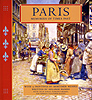 Hando, Solange 2008
Paris: Memories of Times Past. Worth Press Ltd, Cambridge, England. 176 pages.
Hando, Solange 2008
Paris: Memories of Times Past. Worth Press Ltd, Cambridge, England. 176 pages.
- Based on a book published in 1909. an art book about Paris, that included paintings, watercolours, by a
commercial artist called Mortimer Menpes. The book was produced to cater to the taste for travel and art books
at the time and featured innovative ways of printing in colour. The paintings (75) are reproduced here,
accompanied by short descriptive texts, and some supplemental material, lithographs and postcards, that were
contemporary. The images vary greatly in quality. Some are detailed and very good (such as the one on the cover)
others look very slapdash (many of the Seine and bridges). He was obviously influenced by Impressionism, but
many of his paintings are more representational in approach, more like réportage, and these are often the
more attractive ones - especially street scenes. His palette is usually fairly subdued with greys, pinks, blues
and sepia tones predominating. An interesting book with informative text.
(31/Dec/2009)  Pinet,
Hélène 1992 Rodin: The Hands of Genius. Thames and Hudson, London. 143 pages.
Pinet,
Hélène 1992 Rodin: The Hands of Genius. Thames and Hudson, London. 143 pages.
- Pinet provides a short biography of Rodin (1840 - 1917) and description of some of his artworks. She
includes discussion of some of his colleagues and models, notably Camille Claudel, and explores his often uneasy
relationship with his patrons. The book contains many images of his artworks and his studies, and is useful
background reading before visiting the Musée Rodin. This is another essential stop on any cultural
expedition to Paris. Many of Rodin's most famous works, including The Gates of Hell, The Burghers of
Calais, The Thinker, and the statue of Balzac, are scattered about the grounds. Early in the day,
before the grounds get too crowded, this is a great place to wander about. There's also a garden café,
which is a pleasant place to sit and have lunch and recover from cultural overload!
(07/Jul/2007) - Russell, John (editor) 1971 Edouard Vuillard 1868-1940. Thames and Hudson, London. 238 pages.
- Catalogue and book produced for an exhibition of Vuillard's work at the Art Gallery of Ontario in 1971.
Contains essays and extract by various art critics and contemporaries of Vuillard on his work and life. In
addition, many of the works from the exhibition are reproduced. My favourite is Plate XV Interior with a Lady
and a Dog, 1910 which is owned by the Fitzwilliam Museum, Cambridge. The dominant colour is blue but the
room looks so solid and real and very comfortable. It looks a pleasant place to be! Major themes include the
friendship with Bonnard and Roussell, the Natansons (Misia Sert again) and Mallarmé and the whole
vibrant, confident and joyous life of Paris at the turn of the century. Such an amazing explosion of talent at
one time in so many spheres of the arts! Has it ever been repeated? Many of the essays deal with finer points of
art-criticism and techniques and the philosophical basis, such as it was, for the "Nabis (Prophet)"
movement. However, the paintings really speak for themselves and are magnificent.
(14/Nov/1981) - Zamoyski, Adam 1979 Chopin: A New Biography. Collins, London. 336 pages.
- Chopin (1810 - 1849). Born in Poland of a French father and Polish mother, Chopin spent most of his
productive life in Paris in the years of the 1830s and 1840s where many of the composers of the Romantic school
(Liszt, Berlioz) were congregated. An 8-year affair with George Sand has lent an undeserved notoriety to his
name. Chopin was in fact fastidious and fairly conventional. You can find a bust of him in the Luxembourg
Gardens and his grave in the Père Lachaise Cemetery in Paris.
(29/Feb/1988)
Essays and Memoirs
- Flanner, Janet 1972 Paris was Yesterday (1925 - 1939). Viking, New York. 232 pages.
- Although born in the US, Flanner (1892-1978) lived most of her adult life in Europe, including Paris, and
was for many years the European correspondent for The New Yorker magazine. This volume comprises a
selection of her writings from Paris for the magazine. (There's a companion volume based on her time in London,
called London Was Yesterday 1934-1939). She covers social life and political scandals as well as
providing a few longer pieces on some grisly and sensational murder trials. She writes so well that these pieces
are a real pleasure to read. They are still fresh even though many of the personalities she writes about have
faded into obscurity. She was based in Paris at an interesting time. She reports on a world that was still
partly rooted in the 19th century, and despite cars and WWI, seemed to be rather more leisurely and
old-fashioned. Some astonishing personalities were still around, many of the 19th century Impressionists were
still alive in the 1920s and Picasso was just beginning to become famous. Then there was the furore over
publication of James Joyce's novel Ulysses, which seems so tame now.
(31/Mar/1988) - Gallant, Mavis 1986 Paris Notebooks: Essays and Reviews. Macmillan of Canada. 249 pages.
- The first half (almost) of this book is taken up by diary-like jottings taken down during the May 1968 riots
in Paris. Short staccato sentences mimic the confused, dynamic events of the time. What comes across strongly is
the sense of dislocation and bewilderment felt by most people and how the crisis brought to the fore
generational and ideological conflicts within families. I remember the TV reports so clearly that it's hard to
believe these events took place more than forty years ago and the students are all now late middle-aged, some
probably with student-aged grand kids! The other essays deal with major events and figures in France, mainly in
its literary life, although one long essay is a horrified examination of a famous French court-case. The last
fifty pages comprise some book reviews, mainly of French-related books. Erudite and well written, these essays
and reviews make good reading even though their topicality has faded.
(22/Sep/1988) - Pritchett, V. S. 1971 Midnight Oil. Chatto and Windus, London, UK. 253 pages.
- The second volume of Pritchett's literary apprenticeship. At age of 20, he runs away to Paris to earn living
as writer, meanwhile working as a photographer's assistant in order to earn enough to eat. Although Paris in
1920s was suffering a sort of cultural Renaissance, it all passed him by. He was woefully ignorant of the trends
and currents of his own day. Back to London, he was sent to Ireland as correspondent for the Christian
Science Monitor, then he went to Spain and the US, where he describes scenes of terrible poverty and
ignorance in the US Appalachians. He returned to England, once again living in Bloomsbury but not of it. Indeed
he appears not to have heard of the Bloomsbury set. Through the Second World War, when he finally found his feet
and financial security as a writer. The book is written with a good deal of self-mocking humour and gives an
interesting picture of a young man's search for identity and personal development.
(14/Jun/1981)
Paris in literature
 Barbery, Muriel
2008 The Elegance of the Hedgehog. Europa Editions, New York. 304 pages.
Barbery, Muriel
2008 The Elegance of the Hedgehog. Europa Editions, New York. 304 pages.
- A story set in Paris and told in two voices. Renée Michel is a widow, 54 years old, and the concierge
for the last 27 years at 7 rue de Grenelle. She is poor and unattractive, and she does her best to conform to
the stereotype of a concierge in appearance and behaviour, acting gruffly. This allows her to hide in plain
sight. Despite her lack of formal education, she is an autodictat, well-read, and lives a life of the mind,
passionately interested in art, literature and the world of ideas. She despises most of the tenants in the
building, who are rich but pretentious and often rude to her because they see only what they want to see when
they meet her. Our other narrator is Paloma Josse, the ferociously intelligent and well-educated 12-year-old
younger daughter of the Josse family. Her father is in government and her mother is a neurotic social butterfly.
She doesn't get along with her older sister, Colombe, who is writing a thesis on William of Ockham (cf. Occam's
Razor). Paloma has decided the world has no place for her, she is tired of hiding her intelligence from ridicule
so as not to stand out and so she has determined to kill herself on her 13th birthday. In the meantime she
determines to observe her world, recording her observations in a "Journal of the Movement of the
World" and a series of "Profound Thoughts". Through her eyes, we see the obsessive but shallow
world of her family and the social world she is forced to inhabit. Neither Renée nor Paloma are aware of
the anguish and intellectual strivings of the other. And things might have remained that way but for a
precipitating event, the arrival of a new occupant of one of the apartments, Kakuro Ozu, a wealthy elderly
Japanese man. He soon perceives something more to both Renée and Paloma and becomes friends with both of
them. Through him, they become acquainted with each other and are on their way to being friends and allies.
Although neither main character is particularly admirable - it occurs to neither to try to use their
intelligence for the betterment of humanity - yet their voices are distinctive and compelling and the story is
certainly unusual.
(18/Dec/2011) - Bowen, Elizabeth 1935 The House in Paris. Penguin Books. 239 pages.
- This book is very strange but quite enjoyable. Set sometime between the wars, the entire action of the novel
occurs in a single day in a house in Paris, where two children are waiting, Leopold is waiting to meet his
mother, and Henrietta is waiting to catch a train. But Leopold's mother does not appear - in flashback as if she
is telling Leopold, we learn that Leopold is illegitimate, the result of a single encounter between Karen and
Max, who was to have married Naomi Fisher, the daughter of the house in Paris. Eventually, a knock at the door
and Ray arrives, now Karen's husband, who sees that Leopold is needed to complete their marriage. All set out on
their journeys again. Henrietta to the south of France, and Leopold and Ray back, eventually, to England. Naomi
remains in the house in Paris, leading a frustrated life nursing her hypochondriac mother, Mrs Fisher. I have
never understood why Bowen set this novel in Paris, because she didn't live there herself or visit the city as
far as I know. It may have been a way of distancing herself from the locale in order to concentrate attention on
the psychological tension between the characters. Bowen is another one of the twentieth century's under
appreciated writers.
(12/Dec/1987) - Butterworth, Michael 1985 A Virgin on the Rocks. Doubleday, New York, USA. 191 pages
- Set mainly in Paris in 1933, concerns an ingenious plot to switch pictures in the Louvre that rapidly
involves Nazis, the Paris police and other criminal characters. Well written and amusing.
(22/Aug/1987)  Chevalier, Tracy 2005
The Lady and the Unicorn. Plume (Penguin Books). 250 pages.
Chevalier, Tracy 2005
The Lady and the Unicorn. Plume (Penguin Books). 250 pages.
- Spans the years 1490 to 1492 and tells the (imagined) story of the creation of the Lady with Unicorn
tapestries, now a highlight of the collections at the Cluny Museum in Paris. The tapestries are stupendous and
are really well displayed there, in contrast to many of the other artifacts in this and other Paris museums.
Take some time to sit and admire the artistry and the craftsmanship that went into creating them. The true
history of the tapestries - who created them and why - is unknown, but Chevalier bases her tale around the few
known facts (such as the approximate date they were made). The tale is told from the perspective of several
characters. We start with Nicholas des Innocents, an artist, who designs the tapestries for Jean LaViste, an
arriviste nobleman who wants something spectacular to impress people with his wealth and status. The commission
is given to the family of Georges de la Chapelle, a skilled weaver of Brussels. Nicholas is a catalyst who
causes change, not necessarily changes for the better, wherever he goes. Chevalier includes much lore about how
tapestries are created and made, which is the most interesting part of the story. A bit awkwardly written in
places but imaginative and the idea of creating a story behind the artwork is sound. A good read.
(02/Nov/2008) - Closs, Hannah 1959 High are the Mountains. Vanguard Press, New York. 342 pages.
- Set in southwest France (the region known as Occitan), this historical novel deals with the impact of
Catharism and Albigensianism on the political and social life of that region in the 12th - 13th centuries. In
particular, it deals with the sectarian violence that erupted and led ultimately to a northern
"Crusade" led by Simon de Montfort, which ruthlessly exterminated all "heretics". However,
Closs emphasizes that Crusade was undertaken less for religious reasons than from political and economic
imperatives. She highlights the class of two cultures. The South owed much of its ambience and governing
institutions to a tradition unbroken since the Roman and Greek colonization of the Mediterranean shore. In fact,
the lineage may be direct in many cases, as outlined in historian Emmanuel LeRoy Ladurie's books also (see
particularly his Montaillou, published in English in 1980). Closs portrays the North as dominated by
bigoted "barbarians" interested in war and plunder and despising the South as degenerate and
effeminate. Their fanaticism was fuelled by the subtle machinations of Philippe Capet, who has dreams of uniting
France under a single monarchy (his!) and conquering the wealthy South, partly in order to finance his
never-ending tussle with England. A well-written and poetic novel that deals perhaps rather less with events
than it does with ideas, ideals and perceptions. This novel, and Ladurie's historical accounts, highlights the
long-standing regional disparities within France, and the initiation of the centripetal forces that have
resulted in Paris becoming the dominant, and dominating, city.
(27/Dec/1980) - de Beauvoir, Simone 1956 The Mandarins. The World Publishing Company, New York. 610 pages.
- An interesting exploration of the world of the (mainly) left wing political literary intellectuals in Paris
between the end of WWII until about 1950. The tale mainly revolves around the lives of five people: Henri
Perron, a writer and founding editor of the weekly news magazine, L'Espoir; his mistress of ten years,
Paula; Robert Dubrewilh, an older writer and political activist who has been a mentor to Henri for many years;
his wife Anne, a psychiatrist; and their daughter Nadine, aged 18. As the war in Paris is just ending Henri is
trying to break off a cloying relationship with Paula. Henri and Robert have both worked for the Resistance, but
many other writers and associates have not and have either fled to America or collaborated. In the first weeks
of peace, uneasy new relationships are being worked out. In addition, there are stresses between the Communists,
who want to attack America and Marshall Aid and who can see no flaw in Russia, and other leftist socialists,
like Henri, who also hate and distrust America, but see Russia as flawed and are deeply disturbed when the first
reports of the Russian labour camps emerge in the late 1940s. In addition the right wing adherents are split
between the right, who hate the Russians and Communists, and the Gaulists who want to see France as a world
power again. Henri, as editor of L'Espoir, is hard put to it to steer an independent course through these
conflicting views and keep the magazine impartial. Young intellectuals are arguing and writing and former
Resistance fighters are clandestinely executing acquitted collaborators out of revenge. One has the impression
that a lot of energy being expended in futile political discussion. All the characters are seeking some
justification for living and none really find it except in so far as their lives are intertwined with the lives
of others. The novel is intriguing albeit somewhat depressing. Given the history of de Beauvoir and Sartre, the
picture of politics and turmoil in Paris likely reflects the situation they lived through. It makes it easier to
understand later events there, such as the riots of '68.
(01/Jan/1988) - de Beauvoir, Simone 1966 Les Belles Images. Collins, London. 222 pages.
- Laurence, a middle aged Frenchwoman living in Paris in 1960s is troubled by the questions of good and evil
raised by her 10 year old daughter, Catherine. Wealthy and upper middle class, she becomes aware that all her
set concentrates on image not essentials and that none of them really deal with reality. Beauvoir provides an
extended examination of the impact of style over substance.
(06/Dec/1987) - Daley, Robert 1983 The Dangerous Edge. Simon and Schuster, New York. 411 pages.
- Set in France in early 1950s, a France still trying to recover from the effects of WWII. The action occurs
on the Mediterranean coast, mainly Nice and Marseilles. No longer officially conquered, many French still feel
part of a beaten nation. They are particularly resentful of Americans, both the tourists and the crews of the
American fleet that docks every couple of weeks. The area's economy is geared to the fleet's arrival, providing
entertainment and services for the sailors, a fact that is greatly resented by many French. In Nice, an
expatriate American, named Lambert, married to a French woman, plans and executes a bank raid on the main Nice
Bank. He organizes the theft with the help of the local Corsican-run Milieu (Mafia). He plans to steal only gold
and jewels from the bank vault but he also takes some papers. Now not just the police are after him, but also
people who are afraid of blackmail and want him dead. The atmosphere of the coastal region is well evoked and
well done.
(12/Jan/1985) 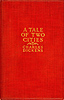 Dickens, Charles 1859 A
Tale of Two Cities. The Bordesley Edition. 374 pages.
Dickens, Charles 1859 A
Tale of Two Cities. The Bordesley Edition. 374 pages.
- It's really impossible to put together a reading list about Paris and not include this novel! It is focussed
around the French Revolution and the fate of the Evremonde family, aristocrats who have brutally oppressed their
people. The last of them, Charles Darnay, has rejected his heritage and fled to England to make a new life for
himself. There he meets Lucy, the daughter of another exiled Frenchman, Dr Manette, and eventually marries her.
Dr Manette had spent 18 years in the Bastille, sent there under a letter of cachet by the former Marquis
d'Evremonde, after helping with a young woman who had been seduced (raped really) by the Marquis's brother, who
turns out to be part of Darnay's family. The woman died and the Marquis had Manette imprisoned to keep this
secret. One of the most striking characters is Madame Dafarge, the wife of Manette's old servant, Ernest
Dafarge. She is one of the true harridans of the Revolution, urging on the citizens to more violence and revenge
and determined to obliterate and exterminate every member of the Evremonde family, a degree of excess that
horrifies her husband. She has knitted a record, a sort of code, of all the people to be killed and as the
executions go on, she sits at the foot of the scaffold, the guillotine, and knits a record of the deaths. (This
knitting code and the role of the women is a brilliant invention by Dickens. This novel can be read, in modern
terms, as a commentary on the subversive power of women). Imprisoned in Paris after an unwise return to France,
Darnay is rescued because Sydney Carton, a dissolute lawyer, trades places with him. They are very alike and the
switch isn't detected and Carton is executed in Darnay's place. As usual with Dickens, the novel relies on a
tangled scheme of improbable connections and coincidence but, because of its drama, is nonetheless compelling.
Dickens' account of the Terror is graphic and powerful. This makes an interesting contrast to the more
romanticized views of the Revolution portrayed by writers such as Baroness Orczy (the Scarlet Pimpernel series).
(19/Apr/1984, 03/Feb/2006)  Dumas, Alexandre 1997
The Count of Monte Cristo. Wordsworth Editions Limited, Ware, Hertfordshire, UK. Originally published in
1846. xxii + 894 pages.
Dumas, Alexandre 1997
The Count of Monte Cristo. Wordsworth Editions Limited, Ware, Hertfordshire, UK. Originally published in
1846. xxii + 894 pages.
- A tale of vengeance. Edmond Dantés, a young sea-captain, is wrongly imprisoned in the infamous
Chateau D'If by a jealous subordinate, Danglars, assisted by his rival for the hand of the beautiful
Mercédes, named Fernand. Fourteen years later, he manages to escape from the Chateau, vowing vengeance
for his wrongs. He knows the location of a fabulous fortune of buried treasure, learned from a fellow-prisoner.
This he recovers and sets out on his trail of vengeance arriving in Paris 10 years later where his rivals are
now all successful and wealthy members of society. His vengeance almost backfires when some innocent people get
hurt. But all eventually ends happily and Dantés sails into the sunset.
(10/Mar/1984, 22/Aug/2010) - Du Maurier, George 1895 Trilby. Harper and Row, New York. 464 pages.
- Story of an artistic colony of Englishmen in Paris in 1850s, who become enamoured of a poor English girl,
Trilby. Describes the bohemian life-style. The novel became well-known for the portrait of the devious and
devilish Svengali, an incomparable musician and odious personality, a manipulator and hypnotist.
(06/Oct/1982) 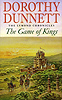 Dunnett, Dorothy, Lymond
Chronicles comprising: The Game of Kings (Michael Joseph, London, originally published 1962,
reprinted 1996, 543 pages), Queen's Play (Michael Joseph, London, originally published 1964, reprinted
1996, 432 pages), The Disorderly Knights (Michael Joseph, London, originally published 1966, reprinted
1996, 503 pages), Pawn in Frankincense (Michael Joseph, London, originally published 1969, reprinted
1998, 486 pages), The Ringed Castle (Michael Joseph, London, originally published 1971, reprinted 1997,
521 pages), Checkmate (Vintage, New York, originally published 1975, reprinted 1997, 581 pages)
Dunnett, Dorothy, Lymond
Chronicles comprising: The Game of Kings (Michael Joseph, London, originally published 1962,
reprinted 1996, 543 pages), Queen's Play (Michael Joseph, London, originally published 1964, reprinted
1996, 432 pages), The Disorderly Knights (Michael Joseph, London, originally published 1966, reprinted
1996, 503 pages), Pawn in Frankincense (Michael Joseph, London, originally published 1969, reprinted
1998, 486 pages), The Ringed Castle (Michael Joseph, London, originally published 1971, reprinted 1997,
521 pages), Checkmate (Vintage, New York, originally published 1975, reprinted 1997, 581 pages)
- The Lymond Chronicles are set mainly in Scotland and France in the mid-sixteenth century. As the series opens, the future Mary, Queen of Scots, is a small child of four years. Scotland is as usual at war with England. And the Scottish nobility are fighting among themselves. Intrigue and treachery are rife. Into this turmoil steps Francis Crawford of Lymond, younger son of the House of Culter. The narrative follows him for several years as he fights to clear his name and claim his inheritance. Lymond travels widely, visiting, among other places, Malta and Iceland. Much of the action in Queen's Play and in Checkmate takes place in France, at the court in Paris, reminding us of the historic ties between Scotland and France - an alliance that was based on mutual hatred of England! There is a companion series to this (The House of Niccolo series, eight books), set a century earlier. Dunnett conceived of the whole series as one long work. The entire fourteen volume series is, quite simply, brilliant. If you only ever read one set of historical novels, read these! Dunnett was a fine historian and her books are known for their historical accuracy and authenticity. She'd never win awards for her writing style, which is sometimes awkward and bland, but she does shine at plot and atmosphere. The stories are dense and complex but totally mesmerizing. I've read the entire series through several times and these would definitely be on my list of all-time favourite books.
 Edge, Arabella 2005 The God of
Spring. Simon and Schuster, New York. 340 pages.
Edge, Arabella 2005 The God of
Spring. Simon and Schuster, New York. 340 pages.
- The title has nothing to do with the novel but refers to the Aztec God of Spring who receives sacrificial
victims. The novel focuses on the life of the painter, Théodore Géricault. As it opens, it is 1818
and he is 26 and in love with his uncle's young wife, Alexandrine, with whom he has been carrying on a torrid
affair. He has had one critical success, with his Charging Chasseur and Wounded Cuirassier (both
can be seen in the Louvre) but is now searching for another subject. A chance conversation with his friend, the
painter Horace Vernat, turns his attention towards the wreck of the Medusa and the horrific suffering of
some survivors, abandoned on a raft, with only 15 out of 150 surviving to be rescued by another ship, the
Argus. The Medusa was taking colonists to one of France's few remaining colonies, Senegal, in west
Africa. The captain was a political appointee and was incompetent. The ship ran aground on a sand bank in good
weather. There were not enough boats to rescue all the passengers and crew, so the captain abandoned most of
them and took off with the boats, despite the fact that the shore was on sight. The survivors drifted for 10
days before being rescued. The case became a scandal, especially when it was rumoured that the survivors had
resorted to cannibalism. Géricault becomes fascinated by this story. He searches out two of the
survivors, Savigny, the ship's doctor, and Corrard, a surveyor, and gets them to recount their experience, which
they don't really want to do, since they want to forget it and enjoy life. Géricault is comparatively
wealthy, so he takes them in as houseguests. He builds a replica of the raft, made by the ship's carpenter, who
also survived, and haunts the morgue, studying corpses and decay to get the right realism for his painting. His
final painting was not a success in France, but it was a hit when it went on tour, on display in London and
Dublin. It is while in Dublin that Géricault suffers a riding accident, the lingering effects of which
lead to his death in 1824 at the early age of 33. Although fictionalized, this is based on actual events,
including the shipwreck, the accounts of the survivors, and Géricault's work on the painting. It is a
tale of obsession, Géricault's obsession to understand what really did happen on the raft. Edge also
includes information about the process of painting, notably the cost and creation of pigments, such as the
bitumen that makes the painting so shadowy and dark. The canvas is on display in the Louvre. It is a powerful
and moving work.
(08/Nov/2008) - Faulks, Sebastian 1989 The Girl at the 'Lion D'Or'. Vintage, London. 249 pages.
- The "Lion D'Or" is a seedy run-down hotel somewhere in northern France, in the small town of
Janvilliers. Sometime towards the end of the 1930s, when the German threat is becoming more obvious and the
spectre of renewed war is horrifying middle-aged Frenchmen who'd gone through WWI, a young girl, Anne, arrives
from Paris to work as a waitress. There she meets Hartmann, a middle-aged lawyer, of Jewish descent, wealthy and
to all accounts successful. They begin an affair, actually fall in love, and Anne tells Hartmann that she is the
child of a WWI soldier who, driven beyond endurance, shot an officer for ordering the men up to the Front again,
and was himself shot by his own troops for murder. Her mother, tormented by the other villagers, took her own
life, leaving Anne an orphan, brought up by a drunken uncaring guardian, Louvain. But she is a survivor and
constructs a life for herself out of this tragedy. Eventually, Anne returns to Paris and we see her beginning to
rebuild her life again while Hartmann confronts the political shadows that loom over France.
(01/Jan/1994) - Foster, Tony 1987 Rue du Bac. Methuen, Toronto. 296 pages.
- A novel dealing with murder and political intrigue in 1980s Paris, focused on a secret from WWI and WWII,
which threatens the security of one of France's leading political figures. It concerns the fate of a group of
girls from the Ardennes, who had been used as amusement by German officers in the war and after the war had been
reabsorbed into society, many marrying well. Now their secret may be revealed by accident and the hunt is on to
kill those involved, including a young French Canadian tourist. Rue du Bac is one of the streets in central
Paris that all tourists walk down at one time or another. This isn't a particularly good thriller - it's an
airplane read - but it connects to an actual place.
(27/Dec/1989) - Freeling, Nicholas 1990 Those in Peril. Mysterious Press, New York. 212 pages.
- Nicholas Freeling is probably best known as the creator of Van Der Valk, a policeman in Amsterdam. The Van
Der Valk stories were made into a popular TV series in the 1970s. Those are entertaining novels, but I have
always preferred his other series focussed on Henri Castaing, a policeman in France. Castaing has a propensity
to follow his conscience rather than doing the politically expedient thing. In earlier stories it had got him
and his family exiled to Lille. Now his superiors want to bury him completely by transferring him to the Beaux
Arts, the Fine Arts Fraud Squad in Paris. Even here, Castaing gets into trouble. Living in an old house on the
outskirts of Paris, he finds out that the local Academedician and TV personality, who gives classes to girls at
the school which his daughters attend, has been interfering with the girls sexually. Such is his influence with
the girls that no one will complain and incidents are hushed up. Castaing determines to end this. His attempt at
entrapment backfires and Castaing's career takes another nose-dive. Other novels in this series include Cold
Iron (1986, Andre Deutsch, 225 pages) set in a small town in northern France, Wolfnight (1982,
Pantheon Books, 200 pages) focussing on right-wing terrorism, and Castaing's City (1980, Pantheon Books,
245 pages) dealing with the assassination of a politician and businessman. Freeling's plots always focus on the
corruption and nepotism of politics in France and the overwhelming influence of the centre (Paris) and the deep
resentment felt by those in the provinces towards those in power. Although born in England, Freeling has lived
for many years in France and seems to get the European atmosphere and locale right.
(22/Jun/1991) - Gallant, Mavis 1985 Overhead in a Balloon: Stories of Paris. Macmillan of Canada. 196 pages.
- Although born in Montreal, Gallant has spent most of her adult life in Paris. She is best known for her
short stories, many of which are set in Paris. This volume comprises twelve stories, several with a linked theme
or at least linked characters. I've also read From the Fifteenth District, another short-story
collection, which was critically well received. McClelland and Stewart bought out a collection of her short
stories under the title Paris Stories in 2002. I don't care much for Gallant's fiction writing, because I
find her tales rather bleak and depressing. However, as a significant literary figure in modern French (and
Canadian) fiction, she's worth reading.
(09/May/1986) - Greene, Graham 1985 The Tenth Man. The Bodley Head, London. 158 pages.
- Written in 1944 for MGM as a screen play but then forgotten, and not published until the 1980s. Greene tells
the tale of Chavel, a rich lawyer, arrested during the war with a group of Frenchmen. The Germans say three must
be shot so they draw lots to decide. Chavel picks one of the unlucky straws but he offers all his fortune and
goods to anyone who'll take his place. A young man called Janvier agrees, so that he can die a rich man and so
he can leave it all to his poor mother and sister. After the war, which Chavel survives, he can't keep away from
his old home, so he goes back, calling himself Charlot and hoping no-one will recognize him. Once there, he
finds Janvier's sister consumed with hatred for Chavel for putting temptation in Janvier's way and depriving her
of her twin brother. Much to his anguish, he finds himself falling in love with her. This novella is memorable
and complex. It's a pity Greene didn't flesh this out to a novel, since it deals with the themes of complexity,
divided loyalties and betrayal that he handles so well. Other than the setting, this has no real relationship to
Paris, or to France either, since the moral dilemma that Greene posits could take place anywhere. But it's a
great read anyway!
(02/Aug/1985) - Harris, Joanne 2002 Five Quarters of the Orange. Harper Books. 307 pages.
- Set in France, now and in WWII. Concerns the recollections of an elderly lady, Framboise Damon, who returns
to the village on the Loire where she grew up. During WWII, the village was occupied by the Germans. Boise and
her brother and sister became friendly with one of them, Tomas Liebnitz, who used the information the kids gave
him to blackmail the locals and enrich himself. When he is found dead, Boise's mother is thought by villagers to
have been responsible. Boise has returned and opened a bistro that features her mother's recipes. Only one man
knows who she is - Paul, a childhood friend who recognizes her through the cooking. When a greedy nephew and
niece threaten to expose her in order to try and get the recipes for their restaurant, Boise determines to tell
the her story, thus breaking the secrecy that has haunted her all her life.
(22/Dec/2002) - Hébert, Anne 1982 Héloïse. Stoddart, Toronto. 101 pages.
- More a short story than a novel, about a young man called Bernard who becomes obsessed by a young girl,
Héloïse, that he sees on the Paris Metro before finding but that she is dead and/or a vampire and is
taking him over. A Gothic novel.
(19/Aug/1983) - James, Henry 1903 The Ambassadors. Signet Books, New American Library. 382 pages.
- This novel deals with Chad Newsome, a young man in Paris in the closing years of the 19th century, son of a
wealthy manufacturing family of Woollett, New England. His mother wants him back in the States to take over the
family business and settle down. She thinks he has got into bad company in Paris, and sends a series of people -
the ambassadors of the title - to bring him back. Lambert Strether is the first of these. He is a journalist who
is the unofficial fiancé of Mrs Newsome. He is in his fifties, has visited Paris in his youth but its
impact on him now is much greater. He finds Chad in a liaison with a middle aged French woman, Madame de
Vionnet. Chad is much improved from the callow youth who left the States and Strether attributes this to her
influence. Strether's delay in Paris and vague letters home cause Mrs Newsome to send another emissary in the
form of her formidable daughter Sarah, who sees Madame de Vionnet as a very unsavoury person and is antipathetic
to the whole atmosphere of Paris. Under her onslaught, Chad capitulates and returns to the States to
respectability. Strether also returns to the States but now to a new and different life. As with all of James's
novels the highly convoluted text, with obscure and elliptic conversation, makes it difficult to understand what
is going on. Nevertheless, this novel documents in part the "American in Paris" experience, which has
become something of a mythology, and is worth reading from that perspective alone.
(19/Feb/1988) 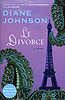 Johnson, Diane 1997 Le Divorce. Plume, Penguin Books. 309 pages.
- Isabel Walker, Californian, mid-20s, has come to Paris to support her older stepsister, Roxeanne, who is
married to a Frenchman, Charles-Henri de Persand, and is expecting her second child. Isabel's task is to act as
a baby-sitter for 3-year-old Gennie, and do odd jobs. Her parents, Chester and Margreeve, hope that she'll find
some direction in life, after she's flunked out of university and film-school. She does, but not in quite the
way they had hoped. Isabel finds herself attracted to Charles-Henri's elderly uncle, Edgar Cossett, a powerful
man, well connected, politically influential, urbane, and sophisticated. He's quite unlike anyone she's ever
met. Meanwhile, Roxy is finding out about the unattractive side of French marital property law after
Charles-Henri deserts her for another woman, Magda. Chester, Roxy's stepfather and Isabel's father, had allowed
her to bring to France a painting of Saint Ursula, possibly by a Renaissance painter, Georges La Tour
(1593-1652). The Getty Museum wants to borrow the painting for an exhibition and when it suddenly appears to be
worth a lot of money, it becomes a matter of dispute in the divorce settlement. Ironic, really, because
Charles-Henri is an artist and painter by profession and Roxy is an increasingly-recognized poet. Written with
wry humour and much comment on mutual cultural misunderstandings, this is an entertaining read. Johnson has
lived in France for many years, so her observations on expat life have the ring of truth. This novel was made
into a Merchant-Ivory movie.
(01/Jul/2012) 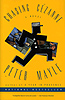 Mayle, Peter 1997 Chasing Cézanne. Vintage Books, New York. 295 pages.
- A lightweight frothy read. Andre Kelley, a magazine art photographer on assignment in the Côte d'Azur,
sees a rare painting being loaded into a plumber's van. His suspicions aroused, he tries to find out why, and
this endeavour sends him and his friends into danger and a chase across France. Contains lyrical descriptions of
food and memorable meals. Provence and Paris are central characters in the story.
(18/Nov/2001) 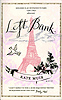 Muir, Kate 2006 Left Bank.
Headline, London 375 pages.
Muir, Kate 2006 Left Bank.
Headline, London 375 pages.
- This novel deals with the lives of two trendy people living in the 7th Arrondissement on the Left Bank in
Paris - the district in which many tourists stay. Olivier Malin is a hip philosopher, very media-friendly,
always riding the wave of the latest trend. Olivier's twin obsessions are food and women. Madison Malin is a
half-American actress, who has made a career out of playing empty-headed nymphets. She is now getting on in
years and the parts she is being offered are leaning rather more towards soft porn than art. They have a
seven-year-old daughter, Sabine, to complete the picture of a happy family. But this is all a facade. Both
parents are competing for the attention of Sabine, who is extremely distressed at the constant bickering and
fighting of her parents. Sabine disappears during a day trip to PlayWorld Paris (a thinly-veiled version of
EuroDisney). Even after she turns up unharmed, the shock of that event acts as a catalyst for change. This
starts off as a frothy comedy but the second half turns into something more serious. This is an airplane book,
but not bad.
(17/Jun/2007) - Perec, George 1978 Life A User's Manual. David R. Godine, Boston. 581 pages.
- Very bizarre, a minute description of a block of flats in Paris on an evening in August 1975 as if purported
to be painted by one of the residents, Serge Valene. The novel consists of a room-by-room description,
incidentally giving much history of the individual inhabitants. The text is all description, no dialogue.
Written by the author who wrote a novel without using the letter "e". Although such a weird book, this
is quite readable and interesting, although the long descriptions do get to be a bit overwhelming after a while.
This book has become something of a cult classic.
(14/Sep/1988) 
 Proust, Marcel 2006 Remembrance of Things Past. Volume 1. 1360 pages. Volume 2. 1294 pages. Wordsworth Editions Limited, Ware, Hertfordshire, UK.
- The first volume comprises the first three novels of this opus: Swann's Way, published in 1913,
Within a Budding Grove, published in 1919, and The Guermantes Way, published in 1921. The second
volume comprises the last four novels: Cities of the Plain published in 1921, The Captive
published in 1922, The Sweet Cheat Gone published in 1925, and Time Regained published in 1927.
The whole comprises one long massive novel. It's a very painterly novel, building up scene and atmosphere by
dense and at time repetitive allusion, continually revisiting and reinterpreting scenes, much as one would be if
recalling a lifetime. The sequence begins in the 1890s. The Dreyfus scandal of 1894 plays a pivotal role in the
plot and characters are identified by being pro- or anti-Dreyfus. Yet Proust seems to hearken back to a much
older and leisurely age. Most of the characters are of the leisured or moneyed class and spend their time in
endless rounds of social engagements and calls, leaving cards and visiting, very much in the mid-19th century
manner. Social class and status is a major concern; people can't talk to someone one to whom they haven't been
formally introduced. The social dance goes on, with current events merely an occasionally intrusive backdrop. So
Victorian seems the milieu that the (very) occasional mention of a telephone, car, motorcycle or electric light
seems jarring and intrusive. The narrator, who seems a selfish, self-indulgent hypochondriac, is concerned with
art and literature, and the development of taste in art is his major preoccupation. He is not, on the whole, a
likable character. Not generous or cordial, very prepared to exploit people for his own ends. Nevertheless, he
is an acute observer of the social scene and is sufficiently cynical and sardonic to perceive the absurdity in
much of the social posturing that does on at the events he attends. Race also plays a major theme. Besides
Dreyfus, Swann is also Jewish, though assimilated, and another character, Bloch, is more obviously Jewish (as
was Proust). The varying reactions of people to these characters highlight a pervasive anti-Semitism in the
contemporary French society, which is highly prescient in view of later events in WWII. Proust seems to view all
life as fairly futile, with only pleasure or, perhaps, the creation of art, as objectives worthy of pursuit.
Many characters, notably the Duc and Duchesse de Guermantes, are obsessed with genealogy and are proud of
tracing their descent from ancient families, though this does not render them likable people, merely gives them
a sense of entitlement and, in the Duc's case, boorish arrogance towards anyone he considers an inferior. The
Proustian style is unmistakable. He writes in long sentences, some of which go on for a page or more, with
dozens of metaphors and allusions and subordinate clauses. It's a pretty tough read and often hard to follow
what is happening and when Proust is being serious and when merely sarcastic. However, it's neat to read about
many of the places to visit, since most of the action is set in Paris or its environs. Each of the districts and
places has social allusions, which non-Parisians probably miss. Although much of the action takes place outside
Paris (Combray in Swann's Way and the Normandy coast in Within a Budding Grove), all the
characters look to Paris as the centre of their world. The story continues through WWI, which barely registers
as an event, in the final three novels. I found these last much more repetitive and tedious. Of them all,
Swann's Way is, in my view, the "must read" volume of this suite.
(19/Sep/2008, 07/Nov/2009) - Rhys, Jean 1939 Good Morning, Midnight. Reprinted 1978. Harper and Row, New York. 190 pages.
- A woman returns to Paris in the 1930s, the place she came to just after WWI, escaping from London with her
husband, the place where he abandoned her, and where her son was born and died soon after. Now she wanders
around the city, trying to avoid the places where she lived before but constantly drawn back to them.
(21/Sep/1990) - Signoret, Simone 1986 Adieu, Volodya. Random House, New York. 418 pages.
- Signoret is best known as an actress, but she was also a writer. Set in Paris from 1920s to 1940s, this
novel tells the tale of two Jewish émigré families, the Roginskis from Poland and the Guttmans
from the Ukraine. The title refers to Vladimir Guttman (Volodya), a cousin of Elie and Sonia Guttman. He does
not manage to escape from Ukraine and Elie meets him only briefly in Paris and before he disappears. We find out
that he died in Irkutsk in the 1920s in one of the early prison camps. He only appears in the middle of the book
for a brief scene, but hovers over the rest of the story - a metaphor for the destruction of the thousands of
Jews in WWII. This is an interesting novel, but distinctly awkward in style, which perhaps owns more to
translation than anything else.
(12/Feb/1988) - Spark, Muriel 1984 The Only Problem. G. P. Putnam's Sons, New York. 179 pages.
- The only problem, according to Harvey Gotham, wealthy Canadian living in the Voges region of France, is the
problem of suffering. Fascinated by the biblical Book of Job, he spends his life pondering it and writing
a treatise on it. Meanwhile, he finds himself almost in the position of Job when his estranged wife Effie is
accused of being a terrorist, part of a gang that has robbed supermarkets, and finally shot a policeman. Now the
police suspect him of sheltering her and financing the gang with money and believe his studies are just a cover
for other activities. Eventually, Effie is killed in a shoot-out in Paris, and Harvey finishes his treatise,
returning to his tranquil and wealthy life.
(07/Jun/1991) - Stendhal, Marie-Henri Beyle de 1831 The Red and the Black. Reprinted 1926. Random House, New York. 638 pages.
- Set in the early decades of the 19th century in France, Julien Sorel, son of a cunning but brutal peasant,
sees the escape from his situation through education and the priesthood. Hence he studies and his learning
permits him to become tutor to the children of Madame de Rênal, with whom he has an affair. Then he goes
to Paris as the secretary to the Marquis de la Mole, whose daughter he seduces. In jealousy, Madame de
Rênal writes a letter to the Marquis denouncing him. Julien shoots her in revenge, without killing her,
but is nevertheless guillotined for his crime. Thus ends his short, ambitious career.
(19/Nov/1982) - Sterne, Laurence 1768 A Sentimental Journey. Oxford University Press. 241 pages.
- The journey is a fictionalized account of a trip that Sterne took to France and Italy, in mockery of the
pretentious European tour taken by young gentlemen of the time. Sterne appears as Mr Yorick and much of his time
is spent in Paris, which was a tourist destination at that time too. Yorick vastly enjoys his trip, in contrast
to other published travellers, such as Tobias Smollett, who complained about the conditions they found. Not
unlike some modern travellers I suppose! Sterne's books are really unclassifiable; there's nothing else quite
like them in English literature. The other novel he's known for writing is The Life and Opinions of Tristram
Shandy, Gentleman. He was a satirist, active in politics, and, rather surprisingly, a clergyman. His humour,
however, could be characterized as, umm, earthy or Rabelaisian.
(13/Nov/1988) - Volkoff, Vladimir 1981 The Turnaround. Translated from French by Alan Sheridan. Doubleday and Co., New York. 296 pages.
- Volsky is of Russian descent and working for the French Secret Service, keeping an eye on the Russians and
translating. He invents a mission called "Culverin" to prevent himself and his section from being
wiped out in an orgy of Government re-organization. "Culverin" is the attempt to "turn" a
Russian KGB major by using his propensity for blondes. So they set up a fictitious mission which rapidly becomes
very real. Volsky gets Mariana, another Russian émigré, to seduce Popov (the major). Instead she
takes him to a Russian orthodox church in Paris. Here Popov, attacked by childhood memories, decides to convert,
become a Christian and "come over" to France bringing secrets with him. Now, in panic the French
Secret Service decide to waste him, because it turns out that the secrets he is bringing include the identity of
a triple agent working for France, USA and USSR who is actually an insignificant member of Volsky's office and
for whom the whole office is merely a front, it's not actually supposed to do anything. The whole affair then
takes on an element of farce with various agents running around Paris trying to find an assassin and the attempt
almost being bungled because the assassin can't find a place to park! But Popov is killed as he is leaving a
church after his First Communion, and remorse causes Volsky to leave the Service. Very well written and
distinctly offbeat. Very good.
(06/Nov/1982) 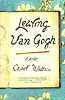 Wallace, Carol 2011 Leaving
Van Gogh. Spiegel and Grau, New York. 268 pages.
Wallace, Carol 2011 Leaving
Van Gogh. Spiegel and Grau, New York. 268 pages.
- An account of the last few months of Vincent van Gogh's life, told from the point of view of Doctor Paul
Gachet (1828-1909), in Auvers-sur-Oise in May to July 1890. Gachet is asked by van Gogh's brother, Théo,
to keep an eye on him and help him if he has more mental attacks. Théo is an art dealer and supports his
brother financially and with art materials, although Vincent's paintings don't sell. Gachet believes that he can
help Vincent and so agrees. In the next few weeks, he feels that they have become friends, as Vincent settles
into the village and begins to paint furiously. Vincent is under stress because he realizes that he is an
immense burden on Théo, who has syphilis and is dying, Suddenly, in midsummer, Vincent finds that he
can't paint anymore. In despair, because the one thing that made life meaningful has been taken from him,
Vincent shoots himself and dies a couple of days later. Much of this account is based on documentary sources,
including the letters that Vincent wrote to his brother. But some parts are speculative, Specifically Wallace
posits that Gachet feels guilt over his failure to help his wife end her life early in the final stages of
consumption, instead watching her die a painful and prolonged death. Because of his guilt at this failure to
act, Wallace has Gachet provide Vincent with a gun, thus being complicit in his death although it is Vincent's
choice. Wallace gives us a potted biography of Gachet showing us how he has been involved in the arts and with
artists through his life (he's in his 60s in 1890), treating Pissaro and Cézanne, among others. He's also
a bit of an amateur artist though he knows his artworks aren't very good. Still, this gives him an appreciation
for what Vincent does. He has also specialized in the treatment of mental illness, with his practice in Paris
(he commutes there weekly) which makes him well-qualified to work with and treat Vincent. Wallace paints him as
a sympathetic figure, conscious of his own limitations and failures. We see Vincent only through his eyes, which
perhaps emphasizes how little we really know about the interior life of any other person.
(20/Sep/2011)  West, Rebecca 1966 The Birds
Fall Down. Virago Modern Classics. 428 pages.
West, Rebecca 1966 The Birds
Fall Down. Virago Modern Classics. 428 pages.
- Set mainly in Paris in the early 1900s, in the household of Count Nikolai Diakanov, an exiled and disgraced
Russian statesman, who has served the Tsar all his life but who has been accused of treason and exiled. Angry
and frustrated, but refusing to believe evil of the Tsar, he broods on his wrongs. The story is seen through the
eyes of Laura Rowan, his 18-year-old granddaughter, offspring of his daughter Tania and Edward Rowan, a British
diplomat and MP. Her parents' marriage is breaking up over an affair of her fathers and Laura is taken to Paris
by her mother. Laura and her grandfather travel by train to see some other relatives. On the train they are
accosted by a man called Chubinov, who is the son of one of Nickolai's closest friends. He has joined the
revolutionaries and is agitating and plotting to overthrow the Tsar. Hence he is anathema to Nikolai. However in
the course of their conversation, Chubinov reveals that Nikolai has been exiled by false information. It becomes
clear that the revolutionaries also have a traitor in their midst and that there is a double agent at work. The
action takes only four days but during this time, the lives of all the protagonists have been changed. According
to the author, this novel is based on a true story. Certainly, Russian émigrés played a
significant role in the artistic and intellectual life of Paris in the years between about 1880 and 1920, and
this novel gives a glimpse of that world.
(01/Dec/1990)
Guidebooks and Maps
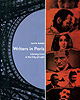 Burke, David 2008 Writers in
Paris: Literary Lives in the City of Light. Counterpoint, Berkeley, California, USA. 248 pages.
Burke, David 2008 Writers in
Paris: Literary Lives in the City of Light. Counterpoint, Berkeley, California, USA. 248 pages.
- Arranged by district in Paris, with a concentration on the central areas around the Sorbonne and Isle de la
Cité and also Montmartre, this tells about some of the famous writers, both French and from overseas, who
have lived in Paris. Burke puts them in context, outlining who lived where, and what they did and, being Paris,
ate. It includes lots about the Paris of the 1920s, including Hemingway, Scott Fitzgerald and James Joyce, of
course. These are the names that are likely to be known to and of interest to North American visitors to Paris,
and this book is clearly targeted at this group. But Burke also includes information about French writers such
as Camus, Malraux, Mauriac, Balzac, Zola, Dumas, and Marcel Proust. Oscar Wilde came to Paris only to die, as
did Jim Morison, a modern icon. Photos of the places and the people bring immediacy to these accounts.
(03/Sep/2008) - Caine, Oriel, and Peter Caine 2008 Frommer's 24 Great Walks in Paris. Frommers. 176 pages.
- I didn't find the Frommer's Travelguide to Paris very useful. In contrast, this walking guide was very useful. We undertook a couple of the walks from this guide, one through the Halles district, and another through the Auteuil district. The routes were clear and easy to follow and we were able to find the architectural and other features described. The walking tour in Auteuil is great if you are into architecture. The walk focussed on buildings by Hector Guimard in the ArtDeco style and also brought us to a small out-of-the-way square that was the site of a massive Rodin sculpture. We'd likely not have found or noticed these without the guide. The notes were brief but informative. Of course, simply walking around the streets is fun, but I did find these notes added an extra dimension to these explorations. I'd recommend a street map as well (see Mapguide below). In a few instances, we had to check the route on a map since the street names were not always obvious, that is, Parisian streets are not always clearly signed.
 Cole, Robert 2008
A Traveller's History of France. Interlink Books, New York. 238 pages.
Cole, Robert 2008
A Traveller's History of France. Interlink Books, New York. 238 pages.
- This is a bit shaky at the beginning but gets better later - the discussion of events since the Revolution
is quite enlightening. Political turmoil has always characterized French life at the centre with swings from
left to right and a constant tension between church and state. Interesting to find that, although northern
France has always dominated the country, Paris really only became important as the centre of government in the
last 200 years or so. The last part of book needs some updating but does cover events of the last few years.
This is a useful potted history. It contains some line drawings. Cole has also written a companion book called,
unsurprisingly, A Traveller's History of Paris (Interlink Books, 2005, 238 pp.).
(17/Aug/2008)  Dorling Kindersley 1993
Paris: EyeWitness Travel Guide. Dorling Kindersley, London, UK 448 pages.
Dorling Kindersley 1993
Paris: EyeWitness Travel Guide. Dorling Kindersley, London, UK 448 pages.
- We took this travel guide with us and it was very useful. In fact, I think this is probably one of the better guides to Paris around, largely because of its profuse and excellent illustrations. It's far too heavy to carry around in a backpack but it is packed with information and useful for consulting in the evenings for background information and to help plan the following day's expedition! My recommendations for "must see" places in Paris includes the Jardin des Plantes and, in particular, the Galerie d'Anatomie Comparée et de Paléontologie, the Louvre, of course, the Musée de Cluny, the Musée Carnavalet (particularly for its central courtyard and small formal garden), the Panthéon, and Notre Dame Cathedral. Other places to wander around include the Place des Vosges, the banks of the Seine, the Isle de la Cité, the Tuileries Gardens, and the Luxembourg Gardens (especially if there's a band playing).
- Middleditch, Michael 2002 Paris Mapguide, 2nd edition. Penguin UK. 64 pages.
- This slender book of maps and gazetteer was very useful. It's easy to slip into a backpack. The maps are clear and legible. Of all the various map guides we checked out, this one was by far the most useful and the one I'd recommend. Ours got copiously annotated during our visits - notably marking the location of good restaurants and patisseries!
 Pozzoli, Milena
Ercole 1997 Paris: Places and History. VMB Publishers, Vercelli, Italy. 128 pages.
Pozzoli, Milena
Ercole 1997 Paris: Places and History. VMB Publishers, Vercelli, Italy. 128 pages.
- I recently picked this book up on-sale on Chapters, not expecting much, but it's actually quite good. As a translation, the English is a bit quaint in places and often rather flowery, but the text is informative and the pictures are great. It also includes a short introduction to Versailles. This is another "must visit" place in (or near) Paris. The crowds are always horrendous, which detracts from the interior tours. But the gardens are wonderful and, even if they are busy, they don't feel that crowded. Getting there early in the day is recommended, when the grounds are at their best.
 Prigent, Serge
2006 Paris: Dates, Facts and Figures. Editions Jean-Paul Gissertot. 192 pages
Prigent, Serge
2006 Paris: Dates, Facts and Figures. Editions Jean-Paul Gissertot. 192 pages
- Similar to Cole's book but focussing on Paris, organized in a chronologic timeline, year by year. A simple record of events with no contextual background. Also includes information about natural events such as floods and famines. Lots of colour photographs are great although it is not always clear how they relate to the text. Some awkward phrases - the translation is not good in places.
 Steves, Rick, Steve Smith, and
Gene Openshaw 2000 et seq. Rick Steves' Paris 2007. Avalon Travel Publishing, Emeryville,
California, USA. 528 pages.
Steves, Rick, Steve Smith, and
Gene Openshaw 2000 et seq. Rick Steves' Paris 2007. Avalon Travel Publishing, Emeryville,
California, USA. 528 pages.
- This was the most useful travel guide of all those that we bought. We used it a lot. It contains good information, useful sketch maps and helpful details, such as how to get around on the Metro (buy a carnet or pack of ten tickets - it's far cheaper), and opening days and times for major attractions. It has some longer sections on specific destinations, such as the Louvre and the Pompidou Centre, which are helpful (and it recommends buying a Museum Pass, which is definitely worthwhile). This book is rather heavy to lug around but worth it. Steves brings out a new edition every year, so the information should be up-to-date. If you only want to take one guidebook, I'd recommend this one. With a street map and a Metro map and this book, you should be able to navigate your way around Paris easily.
Site Guides
 Bayle, Françoise 2001
A Fuller Understanding of the Paintings at Orsay. ArtLys. 224 pages.
Bayle, Françoise 2001
A Fuller Understanding of the Paintings at Orsay. ArtLys. 224 pages.
- Great pictures and some interesting text, but awkward phraseology, obviously translated.
(10/Jul/2007)  Bayle, Françoise
2002 Orsay: Visitor's Guide. ArtLys. 95 pages.
Bayle, Françoise
2002 Orsay: Visitor's Guide. ArtLys. 95 pages.
- A brief survey of the main galleries at the Musée d'Orsay, highlighting some of the major works in
each section, and pointing out the main stylistic trends. Great images of the artworks. Includes the furniture
and Art Noveau designer works.
(15/Jul/2007)  Bayle, Françoise
2006 Monet: A Visit to Giverny. ArtLys. 80 pages.
Bayle, Françoise
2006 Monet: A Visit to Giverny. ArtLys. 80 pages.
- A short discussion of the site, including how Monet came to buy it and live there. The text is awkward and
error-prone but the pictures are generally good and it's a good memento.
(28/Jul/2007)  Bayle, Françoise
2001 Louvre: Visitor's Guide. ArtLys. 104 pages.
Bayle, Françoise
2001 Louvre: Visitor's Guide. ArtLys. 104 pages.
- Full colour reproductions of some of the more famous works in the Louvre arranged by country and theme
(e.g., French paintings). The pictures are great. The captions are short and usually informative, although most
could have been longer.
(11/Aug/2007)  BeauxArts Magazine 2005 The
Rodin Museum. BeauxArts Magazine. 65 pages.
BeauxArts Magazine 2005 The
Rodin Museum. BeauxArts Magazine. 65 pages.
- Several short chapters dealing with the Museum itself and its collections and a short survey of Rodin's
life. Mostly though, this volume is valuable for the great pictures and reproductions of the artworks.
(14/Jul/2007)  Charbonnier, Jean-Michel
(editor) 2006 Musée Carnavalet: History of Paris. Connaissance des Arts. 66 pages.
Charbonnier, Jean-Michel
(editor) 2006 Musée Carnavalet: History of Paris. Connaissance des Arts. 66 pages.
- A short description of the Carnavalet Museum and its contents, highlighting the main collections. This helps
to make more sense of the exhibitions, because the Museum layout seemed rather muddled and confused. Great
pictures too.
(11/Aug/2007) - Connaissance des Arts 2000 Musée des Arts et Métiers. Connaissance des Arts. 67 pages
- A discussion of the museum and its collections, with pictures of the exhibits and the building itself. Also
more about the Collections Centre, which is somewhere on the outskirts of Paris near the airport and which
houses the bulk of the collections (more than 90%).
(14/Jul/2007)  Deligeorges,
Stéphane 1995 The Foucault Pendulum at the Panthéon. Reprinted in 2005. Musée du
Conservatoire national des arts et métiers. 19 pages.
Deligeorges,
Stéphane 1995 The Foucault Pendulum at the Panthéon. Reprinted in 2005. Musée du
Conservatoire national des arts et métiers. 19 pages.
- A short booklet describing the original experiment (1851) and the two subsequent experiments (1902 and
1995). The latter is the installation that we saw in 2007.
(11/Jul/2007)  Erlande-Brandenburg,
Alain 1989 The Lady and the Unicorn. Reprinted 2006. Réunion des musées nationaux. 83
pages.
Erlande-Brandenburg,
Alain 1989 The Lady and the Unicorn. Reprinted 2006. Réunion des musées nationaux. 83
pages.
- Fantastic pictures and reproduction of a truly impressive artwork, housed at the Musée Carnavalet.
Interesting essay but very little about the iconography, mostly about the costumes.
(11/Jul/2007)
 The remarks in black are my comments.
Number of citations: Number of citations:
The remarks in black are my comments.
Number of citations: Number of citations: 

This presentation has been compiled and is ©1998-2025 by
Alwynne B. Beaudoin (bluebulrush@gmail.com)
Last updated February 2, 2025
Alwynne B. Beaudoin (bluebulrush@gmail.com)
Last updated February 2, 2025